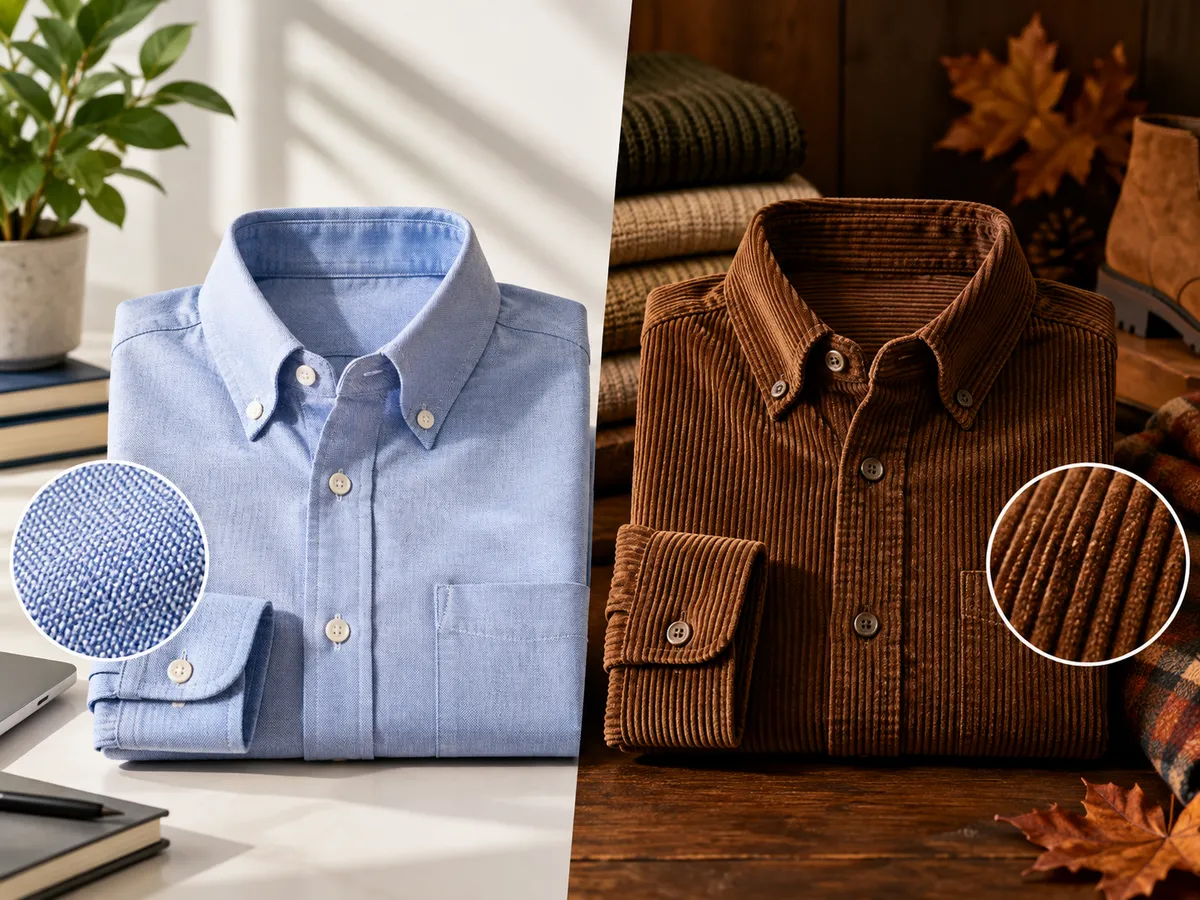
Every retail buyer stocking menswear eventually has this conversation with themselves: Oxford or corduroy? Both are steady sellers in Pyinkado’s own range. The Oxford collection is pitched to retailers as “the shirt retailers trust for year-round demand,” while the Corduroy collection is positioned as “the shirt that bridges casual Friday and weekend street.” Those two lines sum up the actual decision retailers face, and it’s worth breaking down the fabric science behind each claim before you commit shelf space or a purchase order to either one.
This guide covers what Oxford and corduroy actually are, how they compare on the metrics that affect sell-through (weight, breathability, durability, styling range), and which one makes sense to prioritize depending on your market and season. If you’re weighing both for your next stock order, the full Pyinkado collections page has the current color and pattern range for each.
What Is Oxford Cloth, Exactly?
Oxford cloth is a woven cotton fabric identified by its basketweave structure, most often made into what’s called an Oxford shirt. According to Wikipedia’s entry on Oxford cloth, the weave is a 2×1 basketweave, meaning a single weft thread crosses over and under bundles of two warp threads, which produces a slightly looser, textured, lustrous surface compared to a plain weave.
The name’s origin is genuinely disputed, and it’s worth being upfront about that rather than picking one story and presenting it as settled fact. Wikipedia dates the fabric’s emergence to the 18th century, with quality improving through the Industrial Revolution. Separately, several textile trade sources, including Hugh & Crye’s primer on Oxford weave, repeat a different, commonly told account: a Scottish mill in the late 1800s wove four fabrics named after Yale, Cambridge, Harvard and Oxford as a marketing exercise, and Oxford was the only one that stuck. Both claims turn up regularly in industry writing. Neither is fully verifiable from a single primary source, so treat the “four university fabrics” story as trade folklore rather than documented history.
What’s not in dispute is the fabric’s structure and grading. Standard Oxford typically runs 140 to 180 GSM, which is what gives it enough body to hold a collar’s shape without feeling stiff. Within that, there are a few grades worth knowing when you’re placing an order:
- Standard Oxford has the most visible texture and the loosest weave of the three.
- Pinpoint Oxford uses finer, single-ply yarns in a tighter weave, giving it a smoother, dressier finish while keeping Oxford’s basic comfort.
- Royal Oxford is woven even more finely, with a subtle sheen that reads as more formal, closer to what you’d pair with a blazer than a weekend outfit.
Cotton-poly Oxford blends, as detailed in this Oxford fabric guide, trade a small amount of that natural cotton hand-feel for meaningfully better wrinkle resistance and lower shrinkage, which matters if your buyers are stocking for retailers who don’t want customer returns over a shirt that creases on the hanger.
What Is Corduroy, and What Does “Wale Count” Actually Mean?
Corduroy is a cut-pile fabric, not a flat weave. It’s built by weaving in extra yarns that get cut and brushed afterward to create raised vertical ridges called wales. Wikipedia’s corduroy entry puts wale count anywhere from 1.5 to 21 wales per inch, with the traditional standard sitting between 10 and 12. The rule that matters for buyers: the lower the wale number, the thicker and more visible the ridge.
Wale count also predicts weight. Per this corduroy sourcing breakdown, pinwale corduroy generally runs 200 to 250 GSM, standard wale sits around 260 to 340 GSM, and jumbo or elephant cord climbs to 400 to 500 GSM. That’s meaningfully heavier than Oxford across the board, which is the main reason corduroy reads as a colder-weather fabric.
On origin, Sewport’s fabric guide traces corduroy’s ancestry to fustian, a rougher ridged fabric that some textile historians place in Egypt around 200 AD, with the modern, more finely woven version developed by English manufacturers in the 18th century. It’s also had at least one major cultural resurgence: corduroy’s history piece from Cozylant notes its 1970s comeback as a countercultural staple in earthy tones like brown, mustard and olive, which is roughly the same color story driving corduroy’s current streetwear revival among younger shoppers.
Oxford vs Corduroy: A Head-to-Head Comparison
Here’s how the two stack up on the factors that actually affect what moves off a shop floor.
| Attribute | Oxford Cloth | Corduroy |
| Weave structure | Flat basketweave (2×1) | Cut-pile with vertical wales |
| Typical weight | 140 to 180 GSM (standard) | 200 to 500+ GSM depending on wale |
| Breathability | High, suited to warm climates | Lower, pile traps warmth |
| Best season | Year-round, especially warm months | Autumn and winter |
| Durability | Strong, abrasion-resistant weave | Strong, but pile can flatten with wear |
| Styling range | Casual to business-casual | Casual to street style |
| Price positioning | Entry to mid-tier staple | Mid-tier, often a seasonal statement piece |
For a Kerala-based supplier shipping into markets across India and internationally, this table has a practical implication: Oxford’s breathability makes it the safer year-round bet for most of India’s climate, while corduroy earns its shelf space in cooler-season assortments or in markets where autumn-winter buying picks up, whether that’s north Indian winter stock or export orders headed to temperate markets.
Is Oxford a Good Fabric to Stock?
Short answer: yes, and the reasons are structural, not just brand opinion. The basketweave construction is inherently abrasion-resistant, which is why Oxford holds its shape through repeated washing better than a plain weave of comparable weight. Add a cotton-poly blend and you get meaningfully better wrinkle recovery on top of that durability, which matters for a garment that’s going to sit folded on a shelf or get shipped before it’s ever tried on.
That’s consistent with how Pyinkado itself talks about quality control. The About page puts it plainly: “Every fabric choice, every stitch, every wash is deliberate.” Oxford’s fabric science backs that positioning rather than just repeating it as a slogan.
Style It Right: Pairing Oxford and Corduroy on the Shop Floor
One thing retail buyers get asked constantly is whether an Oxford shirt works styled with corduroy trousers. It does, and it’s a combination worth building a merchandising display around, since the flat Oxford weave against corduroy’s ridged texture gives a display visual contrast that a flat lay of two similar fabrics won’t. Pyinkado’s own bottom-wear range, cargo pants, denim jeans and linen trousers, pairs just as well if you’d rather keep both halves of that outfit as a Pyinkado sale.
That’s the same logic Pyinkado’s own blog already lays out for a different fabric. The post on how to merchandise men’s linen for maximum sales breaks display strategy into placement, pairing and storytelling, and that framework applies just as directly to Oxford and corduroy: group by weave or weight rather than only by color, cross-merchandise shirts with trousers you already stock, and label the fabric so buyers understand what they’re paying for.
Which One Should You Stock First?
If you’re choosing between the two for a limited buy, weigh these four factors:
- Climate and region. Oxford’s breathability makes it the lower-risk pick for most of India’s retail calendar. Corduroy performs better where there’s a genuine cool season or an export market with autumn-winter demand.
- Season you’re buying for. If you’re placing a spring or summer order, Oxford is the safer volume play. If you’re building an autumn-winter assortment, corduroy earns its space.
- Gen Z shelf appeal. Corduroy’s earthy-tone streetwear revival gives it strong pull with younger shoppers right now, which lines up with what Euromonitor’s research on menswear in India describes as an ongoing casualisation trend, with Gen Z and Millennial buyers driving demand toward more comfortable, versatile clothing. Oxford’s appeal is steadier and less trend-dependent.
- Price tier. Oxford tends to sit at entry to mid-tier price points, useful for volume. Corduroy, especially wide-wale styles, can be positioned as a seasonal statement piece at a slightly higher price.
For most retailers, the practical answer isn’t “pick one.” It’s Oxford as your year-round volume staple, corduroy as your seasonal or trend-driven layer on top of it. That’s consistent with how Pyinkado frames its own fabric strategy across the Fabric Files blog, including the earlier piece on why linen is the fabric of the Gen Z wardrobe, where a specific fabric earns its slot through a genuine generational shift rather than just being in-season.
If you want to see current colorways for both before deciding, get in touch to stock Pyinkado.
FAQ
1. Is Oxford a good fabric to stock?
Yes. Its basketweave construction is abrasion-resistant and holds shape through repeated washing, and cotton-poly Oxford blends add wrinkle resistance on top of that, which reduces the return risk that comes with a garment sitting folded on a shelf.
2. What’s the actual difference between Oxford and corduroy?
Oxford is a flat basketweave fabric, generally 140 to 180 GSM, prized for breathability and year-round wear. Corduroy is a cut-pile fabric with vertical wales, running anywhere from about 200 to over 500 GSM depending on wale count, and it’s warmer and heavier by design.
3. Does an Oxford shirt work with corduroy pants?
Yes, styling-wise this is a common and effective pairing, since the flat Oxford weave contrasts well against corduroy’s ridged texture. Retailers can build the same look with in-house pieces by pairing Pyinkado Oxford shirts with cargo pants or denim jeans.
4. What wale count should I look for in a corduroy shirt?
Standard wale, around 10 to 12 wales per inch, is the most versatile for shirting. Finer pinwale (up to 16 or higher) leans dressier and lighter; wider wales are typically reserved for trousers and upholstery rather than shirts.
5. Is Oxford cloth suited to India’s climate?
Generally yes. Its breathability makes it one of the more practical shirting fabrics for most of India’s warm-weather retail calendar, which is a large part of why it performs as a year-round staple rather than a seasonal item.